
.svg)
.svg)
*this article first appeared on www.traveldailymedia.com March 2026: full article here
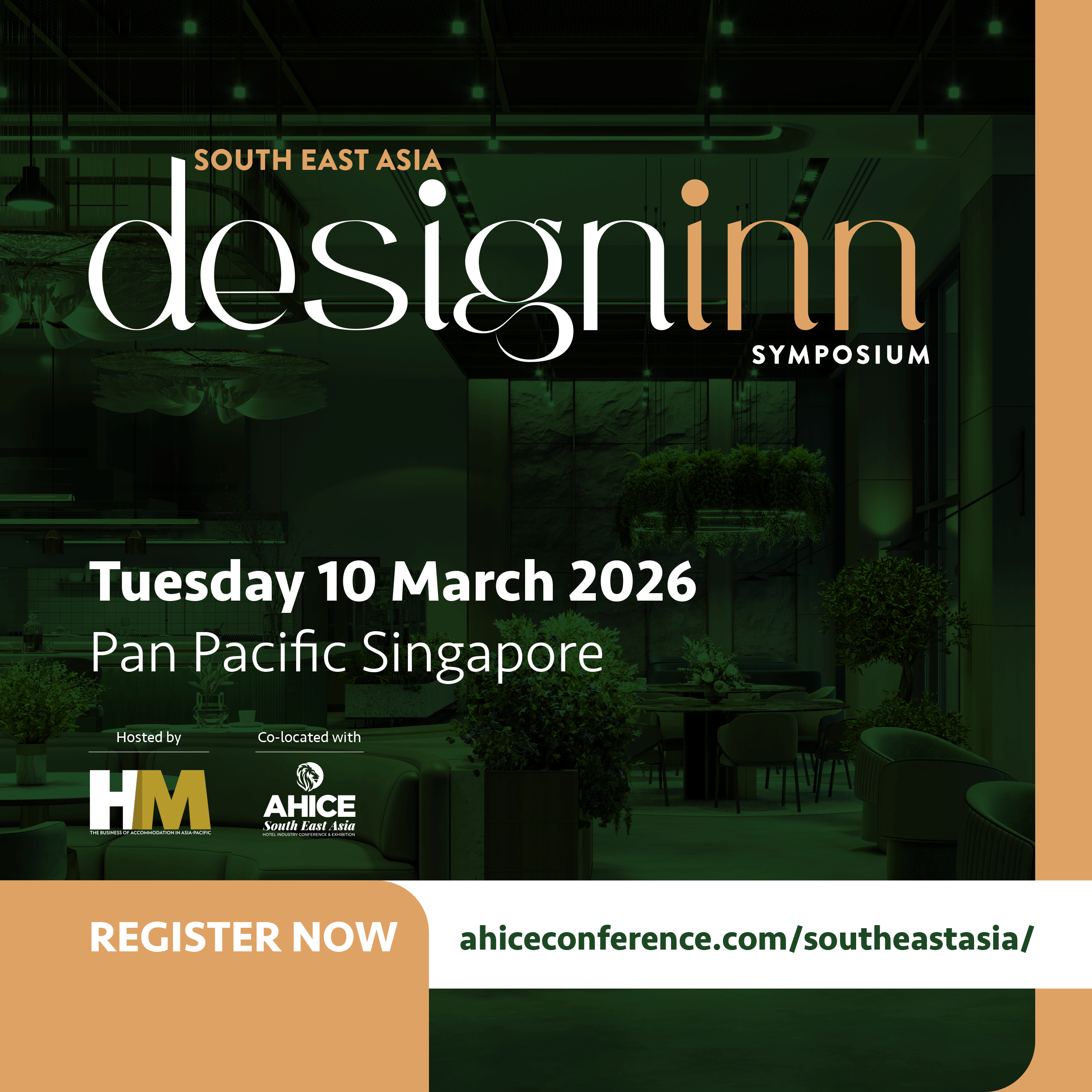
Southeast Asia’s second DesignInn symposium kicked off events for this year’s AHICE Southeast Asia today, 10th March, with a frank panel discussion titled More Than a Place to Sleep: Public Areas That Drive Revenue and Relevance.
Moderated by Design Assembly principal Paul Wiste, the panel featured F&B Social global director for F&B strategy Sam Sheldon, DarkWhite Design Consultancy vice-president for F&B operations Ralph Frehner, and Studio Ryecroft director Bobby Carey.
The discussion pointed out the continuing relevance of public spaces that make properties feel more human, intimate, and personal even in the digital age.
Are we overbuilding the guest experience?
Carey got the conversation started by responding to a question as to whether or not the hospitality sector was overbuilding in terms of guest-facing areas. He said: “As an industry, we're guilty of adding too many layers, especially when it comes to experiences. I do find that we're trying to make the lobby especially different. We're trying to make the lobby something unique, where you can wait, drink, dine, check in, and so forth, people dine and come up later.”
Carey pointed out that designers and property operators are trying to create something that is all-encompassing. However, it is no longer just about how guests interact anymore, nor about how they come and dine and experience hospitality spaces. As he put it: “As you walk into a room or a lobby, there's no real understanding instantly of why we should go in and where we should go.
Within three seconds, what should we do? Should we walk into a room and understand, ‘Okay, this is where I can check in, this is where retail experience is, this is the often-put-in-and-never-utilised library corner that's always going to be in your lobby experience.’ I think it creates a sense of confusion for a guest straight away.”
Should the guest experience in public spaces be ruthlessly engineered?
In the contemporary hotel experience, entering a hotel lobby can be quite confusing, especially in properties that are part of multi-purpose developments and those that offer several facilities on the lobby floor. As Wiste told the panel: “Hotel standard thinking is: We need to have the check-in desk right there, so the guest with the luggage knows exactly where to go.
But they're also saying we want people to come into this lobby and feel like it's a place where they can get coffee or have a meeting or stay for wine and food. Any hotel guest coming to the lobby who needs to stay in the hotel, they have to go to the check-in desk.
Why does it have to be in front of them? Can't it be a little bit further back? Won't they be happier to have a hotel that has a buzzing lobby, because it doesn't feel like there's a check-in desk right in the middle? Can we stick it at the back?”
For this, panellists pointed out that technological advancement can actually streamline the check-in amenities in lobbies: hand-held check-in and app-driven check is becoming a norm among many properties, particularly those in crowd-dense urban areas. However, in resort settings and luxury properties, it needs to be more experiential and it does not necessarily need to tick all the conventional boxes of lobby and even lounge design.
According to Sheldon: “If we're checking into a hotel in Singapore and we have meetings in 15 minutes, we want the lobby and the desk right there so we can check in and get out.
But if we're arriving in the Maldives, give me a gin and tonic and some flowers around my neck and I'm going to sit there for a while and take my time. But I want to check into my billet. I don't want to check in on the space; I'll be off the boat, off the plane, brought to my billet, and I'll check in there. I think that's what we should be aspirationally thinking about doing, and checking out should be the same as well.
Yes, there can be a central space to do that, and this is coming from a design point of view, not an aspirational point of view as well, because sometimes that's not that easy to do.”
From passive space to active revenue generators
Frehner, on the other hand, pointed out one key factor in both experiential hospitality and tourism:”Emotional luxury is something I'm very passionate about, because sometimes people think they can see that, but as a matter of fact, it's actually what people really want to experience.
In my life, I travel to most of the hotels, and I can charge a hotel probably within a few seconds when I walk into a place and I'll see a lobby lounge, which I'm getting really passionate about. People think lobby lounges need more luxury, but I think we should take the existing luxury and activate it properly [at the appropriate times.]”
He also called out what he refers to as the furniture capital: essentially a ton of furniture in a massive space. Frehner said: “Yes, it looks great, but it doesn’t feel great. I see many hotels that give it a very clear concept, so it's activated from the morning where, maybe, it's a very tranquil space where you can have the luxury of silence when you get service. At lunchtime, it's maybe a studio of something, and in the evening it's a stage of something else. But we didn't really change the furniture, we just activated it differently.”

%20%E2%80%94%20V1.jpeg)