
.svg)
.svg)
*this article first appeared on www.observer.com April 2026: full article here
In Tokyo’s hectic Shibuya district, the bespoke wooden speakers beckoning from the double-height wall are the stars of Meikyoku Kissa Lion. Enlivened by a statement chandelier, the dark, moody, Baroque-inspired space—the original, built in 1926, burned down during World War II—has wooed classical music fans for decades.
Here, the ambiance is akin to a salon-style concert, with all attention focused on the spinning record of the moment, its sound amplified through those imposing speakers. Phones are hidden away. Even whispering is verboten. As social life increasingly prioritizes connection, Japanese listening rooms, rooted in jazz, are acting as muse. In these discreet sanctuaries, vast stashes of vinyl savored in communal silence take center stage, continuously informing a flood of high-fidelity bars around the world in various permutations.
For Bobby Carey, co-founder of Singapore-based hospitality consulting firm Studio Ryecroft, the rising allure of listening bars stems from the growing number of international travelers to Japan. Some 20 years ago, when he first visited the country, “there was no English signage, there were no apps.
You wouldn’t have found the listening bars,” Carey recalls. Now, they are accessible to the masses, and some are so besotted with the distinctive experience that they are keen to translate it to their own city when they return. “But they can’t replicate it,” adds Carey. “There is a reverence found in Japanese kissa culture. There’s no talking, no photographs. You light your cigarette, have some whisky, and listen to an album from start to finish.”
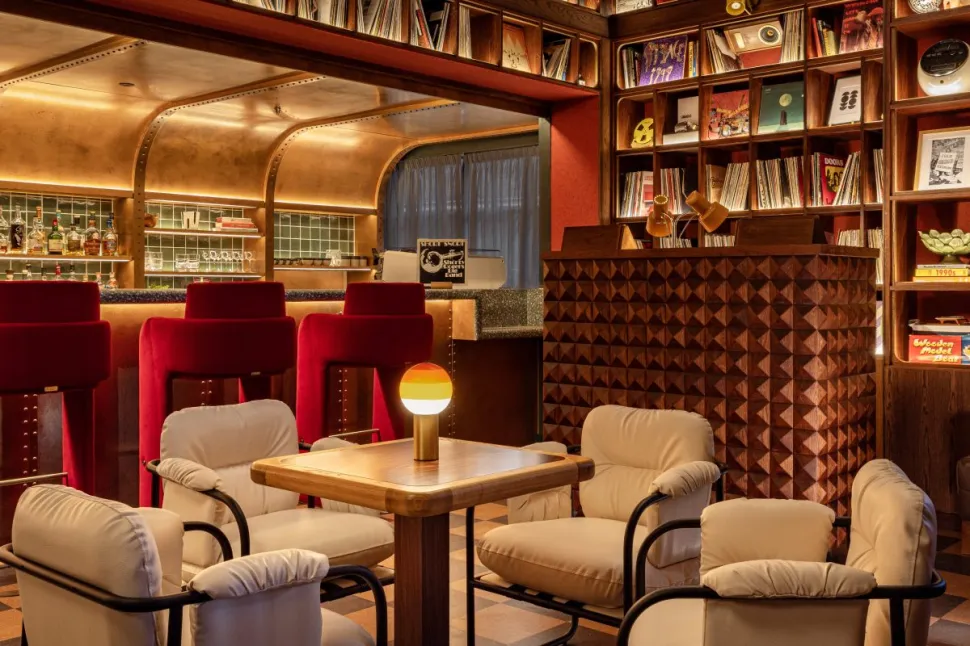
Last year also saw the arrival of Saikindō at the Four Seasons Hotel Abu Dhabi at Al Maryah Island, one of Bobby Carey’s recent projects. Abu Dhabi’s nightlife scene, Carey points out, “is not about sitting in the corner and listening to music. It’s loud, it’s raucous.”
Transposing a Japanese-style record bar to the Middle East was challenging, but Saikindō’s design was pivotal to the process. AvroKO, the firm that conceived it, took cues from Metabolism, the brazen Japanese architecture movement that viewed buildings as living organisms, as well as Bōsōzoku, the Japanese subculture synonymous with flashy DIY motorcycles and embroidered leather jackets.

%20%E2%80%94%20V1.jpeg)